Watch any toddler for an hour: they crouch down to examine an ant in the grass, they wobble along on uneven ground, they tug on your hand and pull you into their game, complete concentration on their faces as they pour water from one container to another. It looks like simple play, but it’s more than that. It’s the brain busy laying down new neural pathways.
Under the surface, the brain is in building mode. As babies and very young children see, hear, touch, smell, taste, move, and interact, they are making millions of connection points (“synapses”) that form a network of neural pathways for messages to travel along. Connections that are rarely used are slowly trimmed away (“pruned”), which helps the brain work more efficiently. When children repeat play experiences that give the brain and body a lot to work with, certain pathways get stronger, quicker, and easier to use.[1]
This means the type of play space your childcare offers really matters. If your Brisbane Kindy offers nature-based play, they are setting the scene for a strong foundation in lifelong learning and wellbeing.
What makes nature-based play unique?
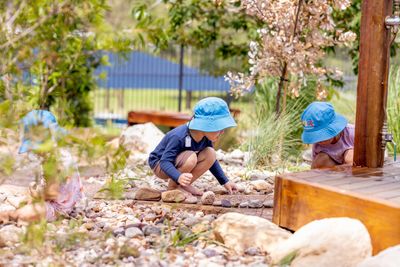
Traditional playgrounds with climbing frames, slides, swings, and push cars are activity-based and engage children in short bursts of energy. Cubbyhouses and sandpits inspire creativity and imagination. However, nature-based play environments invite all of this and more. They are less scripted and more child-led.
Science tells us that in nature-based childcare settings, children engage in longer, more complex play than in traditional playgrounds.[2] In a single day, a four-year-old might cross fallen logs to save a friend from “danger,” survey their terrain from on top of a hill, discover buried hidden treasures, play pirates on the timber fort, taste-test edibles from the garden, sell pies from the mud kitchen, look in on a busy community of stingless native bees, engage in waterplay or stage races on the lawn, and spend contemplative time in the yarning circle.
Natural elements like rocks, logs, plants, sand and water feed the senses in ways that plastic and metal structures simply cannot. They invite children to look more closely, figure things out, and share discoveries with friends.
These aren’t new ideas. They trace back to Friedrich Fröbel, the 19th-century educational philosopher, who coined the term “kindergarten,” which literally means “children’s garden.” Still central to early learning today, this philosophy prioritises exploring and playing as the best way for children in this age group to learn.
“The natural environment has made a difference for Toby. I have seen him explore with confidence, enjoy being outdoors, seeing loads of blue and green. He is genuinely happy to be there,” Ashley Sedgemen, mum of Toby, who goes to Brisbane Adventist Kindergarten
The whole child benefits from nature play
When children engage in nature-play environments, it’s not just their legs and lungs that are working. Whole bodies, busy brains, and big feelings are getting a workout, too.
1. Physical development
If you look at Australia’s Early Years Learning Framework, you’ll see that early learning educators place great emphasis on children developing “movement patterns, mobility and gross motor skills.”[3]
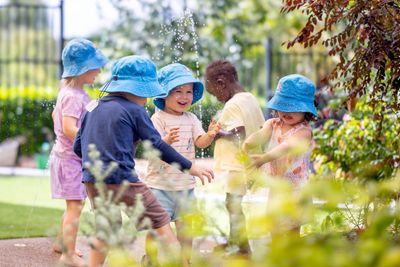
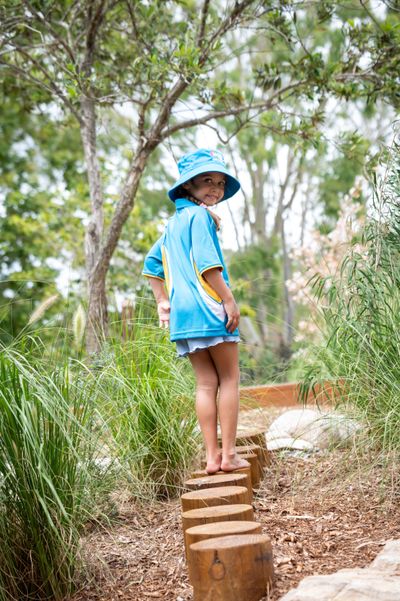
These are the “big” movement skills like balance and stability, moving multiple body parts at the same time, and using muscles to build strength. Nature-based play is energetic. Children cross uneven surfaces and engage in a wide variety of movements – from crawling under bushes to jumping over logs and scrambling up small hills – all of which build strong, confident bodies. Over time, active, outdoor play supports a healthy immune system and body weight.[4]
2. Cognitive and creative development
Some parents assume that the best way to grow their preschool child’s intellect is to spend time in organised, classroom learning. But researchers make it clear that, in the early years, unhurried hands-on play – especially when it occurs outdoors in nature – is a powerful driver of problem-solving, planning and creativity, which are the key building blocks of intelligence.
The part of the brain that supports learning is called the “prefrontal cortex.” It’s the control centre, or coach, located closest to the forehead, that helps children:
- pause, stop, and think, instead of acting on impulse
- plan what to do next and then hold the next steps in their memory
- solve problems and change strategies if something doesn’t work
- manage feelings enough to stay with a challenge and get along with others
These skills grow rapidly from about two to six years of age and continue developing more slowly into the early 20s.[5] Nature-based play gives the prefrontal cortex exactly the kind of workout it needs. Children choose which route to take, decide how to build and create, remember the rules of the game they’re playing with friends, work out what to try next, and when something fails, try something new. Confidence, curiosity, and resilience are built through real experiences, and time in nature has a calming effect that makes it easier for children to stay focused and keep trying.[6]
3. Social-emotional development
Studies have found positive social and emotional links for children in the creative, unscripted moments of nature play. They are more likely to get along with others, including those from different cultural backgrounds, develop genuine friendships, and spend more quiet, reflective time – all of which contribute to better wellbeing.[7] Researchers also discovered that children who play in nature-based environments develop an interest in nature that traditional playgrounds cannot offer.
Taken together, these physical, thinking, and social-emotional benefits mean that a good nature-play program isn’t just an added “extra”; it’s one of the most effective ways to support the whole child in their early years.
“Checking in on the possum has become a meaningful routine. The children remind one another to use quiet voices, to look but not touch, and they often feel concerned when they don’t see him – showing genuine attachment and care,” Mrs M Pule, Educational Leader.
The working parent’s peace of mind
When a working parent leaves their very young child at childcare, it is also often the first time they’ve entrusted their child to someone who is not family. Parents are looking for a place their child genuinely wants to return to – where the child’s own excitement at arriving tells the story of safety, engagement, and a sense of being known.
A thoughtfully designed nature play area is a good sign that a childcare service is thinking beyond supervision to deep learning and wellbeing. When children spend a good proportion of their days creating, caring for living things, and stretching their bodies and minds, they’re not just passing time.
“As soon as we get here, he wants to run out to the playground to see what's happening,” Mother of a child at Brisbane Adventist Early Learning.
The environments we choose for our children really matter. If you’re in the Mansfield, Brisbane, or surrounding areas, and searching for the right fit for you and your child, we’d love to show you around Brisbane Adventist Early Learning. Drop by and see, firsthand, how kids from six weeks to five engage with our purposefully designed Nature-Based Play Space – it’s truly better than our photos can capture.
Find us on our website, book a tour, or learn more about our Early Learning and Kindy program.
[See more photos of Brisbane Adventist Early Learning Nature-based playground here.]
SOURCES
[1] https://neuroscience.ucdavis.edu/news/making-and-breaking-connections-brain
[2] https://pmc.ncbi.nlm.nih.gov/articles/PMC9687100/
[3] https://www.acecqa.gov.au/sites/default/files/2023-01/EYLF-2022-V2.0.pdf
[4] https://pmc.ncbi.nlm.nih.gov/articles/PMC4571181/
[5] https://pubmed.ncbi.nlm.nih.gov/18467667/
[6] https://www.pnas.org/doi/abs/10.1073/pnas.1510459112
[7] https://research.childrenandnature.org/research/nature-based-early-childhood-education-may-support-childrens-growth-in-multiple-areas-of-social-emotional-and-cognitive-development/
